
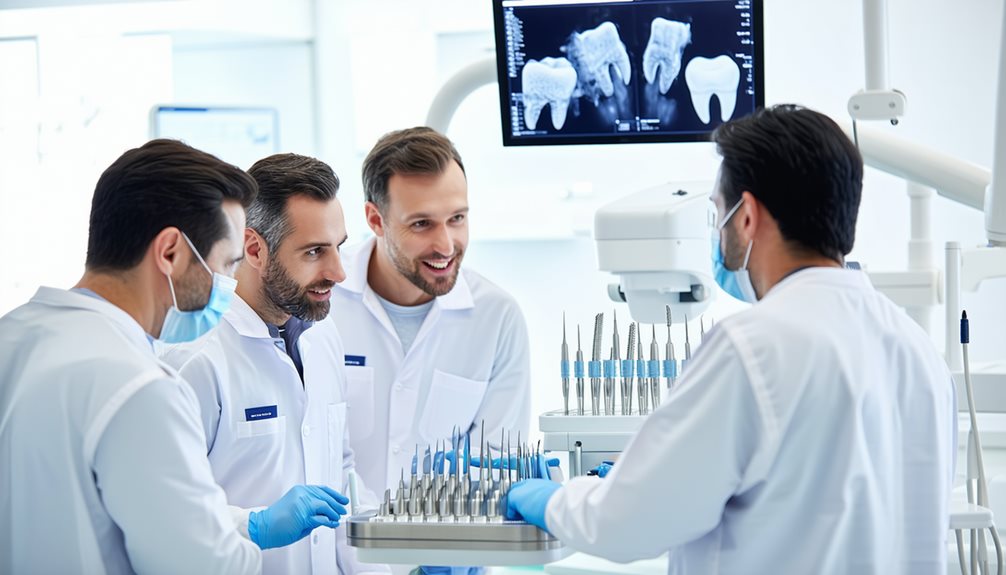
Top endodontic specialists excel in managing complex dental treatments through a combination of technical expertise and cutting-edge technology. These experts possess advanced skills in diagnosing and treating intricate cases that conventional methods might not solve, utilizing rotary instrumentation and dental operating microscopes for enhanced precision. They leverage three-dimensional imaging techniques like cone beam computed tomography for accurate assessments. Additionally, their adoption of biologically based procedures and regenerative endodontics drives innovation in tooth preservation. Emphasizing patient-centered care, they employ advanced anesthetics and pain management techniques, ensuring customized treatment plans. Their continuous pursuit of education and skill enhancement elevates standard care practices—more can be discovered from this domain.
Leading Experts in Endodontics
In the domain of endodontics, leading experts are distinguished by their advanced technical skills and extensive understanding of dental anatomy and pathology. These professionals are adept at utilizing cutting edge techniques to address complex dental issues, ensuring favorable patient outcomes. Their proficiency is not merely in executing procedures but also in diagnosing intricate cases where conventional methods may falter.
Such expertise in endodontics is underpinned by a robust foundation in both theoretical knowledge and practical application, enabling these specialists to innovate and refine treatment protocols continuously.
Endodontic specialists engage in expert consultations, often collaborating with general dentists and other dental professionals to devise thorough treatment plans. This multidisciplinary approach allows for a more nuanced understanding of each patient’s unique dental architecture, thereby tailoring interventions to specific needs.
The objective analysis of case studies and current research further fortifies their decision-making processes, ensuring that they remain at the forefront of dental innovation. As the field of endodontics evolves, these experts continue to push the boundaries of what is possible, leveraging technology and advanced methodologies to enhance the precision and efficiency of their treatments, ultimately advancing the standard of care within the industry.
Specialists in Root Canal Therapy
Root canal therapy, a cornerstone of endodontic treatment, requires specialized expertise to address complex dental issues effectively.
Advanced techniques in root canal procedures have notably enhanced the precision and success rates of these treatments, minimizing the risk of complications.
Moreover, innovative pain management strategies play a critical role in improving patient comfort and outcomes during and after the procedure.
Advanced Root Canal Techniques
Among the numerous advancements in endodontic treatment, the refinement of root canal techniques has markedly improved patient outcomes and procedural efficiency. Innovations in endodontic technology have paved the way for enhanced precision and success rates in complex treatments. One such advancement is the use of rotary instrumentation, which has revolutionized the traditional hand-filing methods. These motorized devices allow for more consistent shaping of the root canal, reducing the risk of procedural errors and improving the cleaning efficacy.
Another significant development is the enhanced visualization through dental operating microscopes. This tool provides endodontists with magnified views, enabling better identification and treatment of intricate canal anatomies that were previously challenging to address.
In addition, cone beam computed tomography (CBCT) imaging offers three-dimensional perspectives of the tooth structure, aiding in accurate diagnosis and treatment planning.
The integration of biocompatible materials in root canal therapy has also been transformative. Materials such as mineral trioxide aggregate (MTA) are now preferred for their superior sealing properties and biological compatibility, promoting healing and reducing post-procedural complications.
These root canal advancements collectively signify a paradigm shift in endodontic care, ensuring that even the most complex cases can be managed with greater confidence and success.
Pain Management Strategies
Pain management is a critical component of successful root canal therapy, necessitating a tailored approach by endodontic specialists to guarantee patient comfort and procedural success. The complexity of endodontic treatments demands precision in managing both acute pain during procedures and chronic pain that may persist post-therapy. Specialists employ cutting-edge techniques and technologies to address these pain challenges efficiently.
Key strategies in pain management include:
-
Preoperative Assessment: Thorough evaluation of the patient’s pain history and current status to differentiate between chronic pain and acute pain, ensuring customized treatment plans.
-
Local Anesthesia Innovations: Utilization of advanced anesthetic agents and delivery systems to enhance efficacy and minimize discomfort, reducing the risk of acute pain during the procedure.
-
Non-Pharmacological Techniques: Incorporation of methods such as laser therapy and transcutaneous electrical nerve stimulation (TENS) to manage pain without relying solely on medication.
-
Postoperative Care Protocols: Development of extensive aftercare strategies to manage potential chronic pain, involving both pharmacological and non-pharmacological interventions.
Endodontic specialists must remain at the forefront of pain management innovation, integrating new research findings and technological advancements.
This proactive approach not only elevates patient care but also enhances the overall success rate of complex root canal therapies, paving the way for future developments in endodontic practice.
Advanced Pain Management Techniques
In the domain of endodontics, advanced pain management techniques focus on minimizing patient discomfort through a combination of precision pain assessment and innovative anesthetic options.
Endodontic specialists employ state-of-the-art diagnostic tools to accurately evaluate pain levels, allowing for tailored intervention strategies that enhance patient comfort.
Additionally, the integration of novel anesthetics and delivery systems guarantees effective pain control, optimizing treatment outcomes in complex endodontic procedures.
Minimizing Patient Discomfort
Effective pain management is a critical component in endodontic treatments, particularly in complex cases where patient discomfort can be more pronounced. Advanced techniques that minimize discomfort are essential for enhancing patient experience and outcomes.
Leveraging a multidisciplinary approach, specialists integrate patient education and relaxation techniques as foundational strategies to mitigate pain perception. Educating patients about the procedure helps in reducing anxiety, thereby lowering pain sensitivity. Additionally, relaxation techniques such as guided imagery and controlled breathing are employed to promote physiological calmness.
The following advanced methods are utilized to further minimize discomfort:
- Preemptive Analgesia: Administering analgesics before the procedure to prevent pain sensation.
- Local Anesthetic Innovations: Utilizing buffered anesthetics to enhance efficacy and reduce injection site discomfort.
- Laser-Assisted Procedures: Employing lasers to minimize tissue trauma and promote faster healing.
- Digital Imaging Technologies: Enhancing precision in treatment planning to reduce procedural time and associated discomfort.
Precision Pain Assessment
Precision pain assessment is a cornerstone in the advanced management of endodontic treatments. The ability to accurately evaluate pain levels is essential for tailoring interventions that optimize patient comfort and treatment efficacy.
Cutting-edge diagnostic imaging plays a pivotal role in this process, allowing endodontists to visualize complex anatomical structures and potential sources of discomfort with unparalleled accuracy.
Patient feedback is another critical component in precision pain assessment. By actively engaging patients in the evaluation process, endodontic specialists can gain nuanced understanding of pain experiences, which aids in refining diagnostic hypotheses and treatment plans.
This patient-centered approach not only fosters trust but also guarantees that management strategies are responsive to the individual’s specific pain profile.
Innovative pain assessment techniques are continuously evolving, driven by the integration of technology and data analytics. By harnessing these advancements, endodontic specialists are positioned to deliver more precise, personalized care.
This emphasis on precise pain assessment underscores a commitment to pioneering solutions that enhance patient outcomes in complex endodontic cases.
Innovative Anesthetic Options
Frequently, advancements in anesthetic options redefine the landscape of pain management in endodontic treatments. With a focus on enhancing patient comfort and procedural efficacy, local anesthetic advancements have greatly improved the predictability and depth of anesthesia.
The integration of novel formulations, such as buffered anesthetics, has minimized onset time and increased patient satisfaction. These developments are critical as they address the variability in anesthetic response, a common challenge in complex endodontic procedures.
Sedation dentistry techniques have evolved to complement local anesthetic advancements, offering tailored solutions for patients with heightened anxiety or those undergoing intricate treatments. The application of conscious sedation, for instance, has provided practitioners with increased flexibility in managing patient comfort and cooperation.
Innovative anesthetic options include:
- Buffered anesthetics: Rapid onset, minimizes patient discomfort.
- Computer-controlled delivery systems: Precise dosing, reduces pain perception.
- Nitrous oxide sedation: Safe, effective for anxiety management.
- Intravenous sedation: ideal for extensive procedures requiring deeper sedation.
These cutting-edge techniques underscore the importance of continual innovation in endodontics, ensuring that specialists are equipped with the most effective tools for managing complex treatments.
As the field progresses, the focus remains on achieving superior patient outcomes through refined anesthetic methodologies.
Innovations in Endodontic Surgery
In recent years, endodontic surgery has undergone considerable advancements that have transformed treatment outcomes and patient experiences. Among these innovations, regenerative endodontics has emerged as a crucial technique, promising to revolutionize the way clinicians approach tooth preservation and pulp health.
By employing biologically based procedures aimed at restoring damaged tissues, regenerative endodontics offers the potential to regenerate dental pulp and dentin complexes, thereby enhancing the longevity and functionality of treated teeth. This approach not only mitigates the need for traditional root canal procedures but also aligns with the overarching trend towards minimally invasive dentistry.
Concurrently, digital imaging has become an essential tool in endodontic surgery, facilitating enhanced precision and accuracy in diagnostics and treatment planning. Advanced imaging modalities, such as cone-beam computed tomography (CBCT), provide three-dimensional views that enable clinicians to visualize complex root canal anatomies, detect periapical pathologies, and assess treatment efficacy with unprecedented clarity.
This technological integration has considerably reduced procedural risks and improved patient outcomes by allowing for tailored, patient-specific surgical interventions. As endodontic surgery continues to evolve, these innovations underscore the commitment to optimizing patient care through evidence-based practices and cutting-edge technology.
Pioneers in Microscope-Assisted Procedures
How have advancements in microscope-assisted procedures reshaped endodontic treatments? The integration of microscope technology has greatly enhanced the precision and outcomes of endodontic procedures.
By offering magnification and illumination, microscopes have allowed endodontists to visualize intricate anatomical structures with unparalleled clarity, thereby improving treatment accuracy.
Pioneers in this field have revolutionized the approach to complex endodontic cases, ensuring that even the most challenging conditions can be addressed with confidence and precision.
The benefits of microscope-assisted procedures include:
-
Enhanced Visualization: Microscopes provide high magnification, enabling endodontists to detect minute canal structures and cracks that were previously undetectable.
-
Improved Treatment Accuracy: With better visibility, the precision of procedures such as root canal treatments and apicoectomies is greatly increased, leading to higher success rates.
-
Minimized Invasive Techniques: The detailed view allows for more conservative approaches, preserving as much natural tooth structure as possible.
-
Reduced Treatment Time: Efficient identification and management of root canal complexities lead to quicker procedures and faster patient recovery.
Top-Rated Endodontic Clinics
When evaluating top-rated endodontic clinics, the focus is on their ability to deliver exceptional patient care through advanced technology and skilled practitioners.
These clinics leverage cutting-edge equipment such as cone beam computed tomography (CBCT) and operating microscopes to enhance diagnostic accuracy and procedural precision. The integration of these technologies guarantees minimally invasive treatments, optimizing patient outcomes and comfort.
Patient reviews often highlight the efficacy of such innovations, reflecting a clinic’s commitment to excellence. A thorough assessment of clinic comparisons reveals that top-rated establishments maintain a consistent track record of successful treatments, underscoring their proficiency in handling complex endodontic cases.
Additionally, the expertise of practitioners in these clinics is pivotal; they are often board-certified specialists with extensive experience in endodontics, further elevating the standard of care provided.
Clinics that rank highly in patient reviews typically exhibit streamlined processes, from consultation to post-operative care, guaranteeing a seamless patient experience.
Furthermore, these clinics invest in continuous education and training for their staff, fostering an environment of innovation and learning. As the demand for specialized endodontic care grows, clinics that prioritize technological advancement and expert skill sets will continue to lead the field.
Frequently Asked Questions
What Is the Average Cost of Complex Endodontic Treatments?
The average cost of complex endodontic treatments ranges from $1,000 to $2,500, influenced by treatment pricing variables. Insurance coverage may offset these expenses, though coverage extent varies, demanding thorough policy examination and potential innovative financial planning.
How Long Does Recovery Typically Take After Endodontic Surgery?
Recovery after endodontic surgery typically spans 7 to 10 days. Post-surgery care protocols, including effective pain management strategies, are essential for ideal healing outcomes. Innovations in these areas continue to enhance patient experience and expedite recovery.
Are There Non-Surgical Alternatives to Traditional Root Canal Therapy?
Non-surgical alternatives to traditional root canal therapy include holistic approaches and laser therapy. Holistic methods emphasize overall health, while laser therapy offers minimally invasive options by targeting infected tissues with precision, enhancing treatment efficacy and promoting innovative dental care.
How Do I Know if My Dentist Is an Endodontic Specialist?
To determine if your dentist is an endodontic specialist, verify their qualifications which should include advanced specialist training in endodontics. This typically involves additional years of education and certification beyond general dentistry, ensuring expert proficiency.
What Should I Expect During My First Endodontic Consultation?
During your first endodontic consultation, expect an initial examination utilizing advanced diagnostic tools. The endodontist will analyze your condition and discuss innovative treatment options tailored to your needs, ensuring an objective approach for ideal dental health outcomes.
Conclusion
The landscape of endodontics is marked by specialists who excel in complex treatments, utilizing advanced techniques in root canal therapy and pain management. These experts lead innovations in endodontic surgery and are pioneers in microscope-assisted procedures, enhancing precision and outcomes. Top-rated clinics are distinguished by their commitment to excellence and cutting-edge technology, providing patients with superior care. Collectively, these advancements underscore the field’s dedication to addressing intricate dental challenges with expertise and innovation.
